Top 7 Digital Tools Every University Student Needs for Research
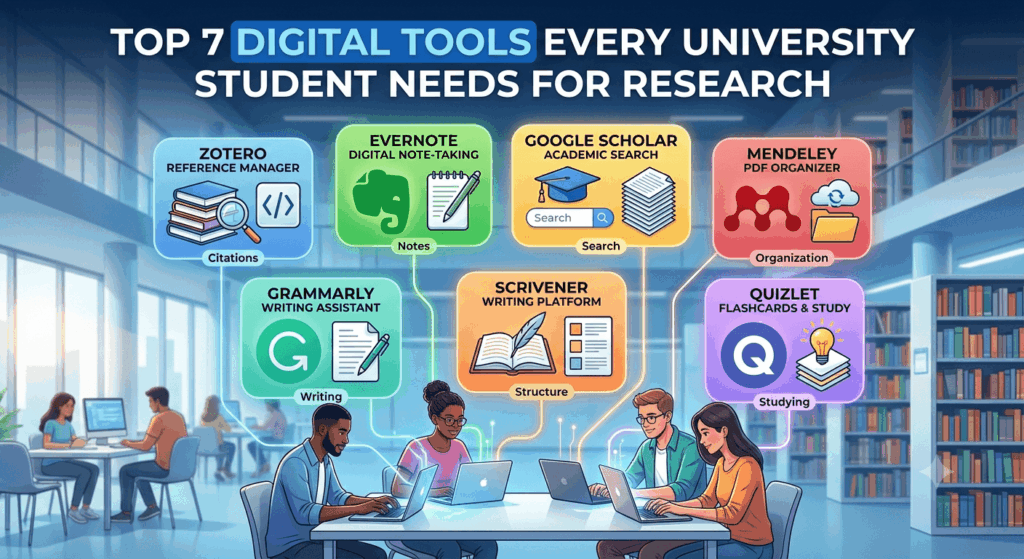
Let’s be honest research as a university student in Ethiopia comes with its own set of challenges. Between inconsistent Wi-Fi coverage, limited access to subscription-based academic resources, and the sheer volume of information out there, doing proper research can feel like an uphill battle.
But here’s the good news: the digital landscape in Ethiopia is evolving fast. With initiatives like EthERNet (Ethiopian Education and Research Network) connecting over 50 institutions and the National Academic Digital Library hosting more than 80,000 academic resources, students today have access to tools that previous generations could only dream of.
The key is knowing which tools actually work and using them wisely.
Whether you’re at Addis Ababa University, Bahir Dar University, or anywhere in between, here are seven digital tools that will transform how you approach research.
1. National Academic Digital Library of Ethiopia (NADLE)
Let’s start with the obvious one because if you’re not using this, you’re missing out on a goldmine.
The National Academic Digital Library of Ethiopia, under the Ministry of Education, is a free Open Educational Resources (OER) platform that collects and organizes academic materials from national and international digital libraries. We’re talking textbooks, scholarly articles, audiobooks, lectures, simulations over 80,000 items authored by more than 30,000 contributors.
Why it matters for Ethiopian students: Most universities in Ethiopia face limited access to expensive subscription-based journals. NADLE bridges that gap by providing free access to resources you’d otherwise struggle to find. And the best part? You don’t even need to log in.
How to use it: Visit ndl.ethernet.edu.et, click the “Undergraduate” button, and browse by subject or search by topic. Whether you’re studying economics, engineering, or literature, chances are there’s something there for you.
2. Google Scholar
You’ve probably heard of it. You might even use it. But are you using it right?
Google Scholar is more than just a search engine for academic papers it’s a gateway to peer-reviewed articles, theses, books, and court opinions from all over the world. And unlike many databases that hide behind paywalls, Google Scholar often links to free versions of papers when they’re available.
Why it matters for Ethiopian students: Ethiopian university libraries are increasingly providing access to international journals through partnerships with publishers like Elsevier and Wiley. Google Scholar helps you discover what’s out there, and once you find something useful, you can check if your university library provides access.
Pro tip: Connect your Google Scholar account to your university library. Go to Settings → Library Links and search for your institution. This way, you’ll see “Find it at [Your University]” links right next to search results.
3. Canvas Student Platform
Here’s something that’s already making waves in Ethiopian higher education.
A study at Bahir Dar University found that 96% of students agreed that mobile technology specifically through the Canvas Student platform was essential for improving their academic performance and engagement. Students used it for everything from accessing course materials to collaborating with classmates across libraries and outdoor Wi-Fi areas.
Why it matters for Ethiopian students: Canvas isn’t just a tool for submitting assignments. It’s a mobile-assisted learning platform that helps you stay organized, access lecture notes, participate in discussions, and keep track of deadlines all from your phone.
How to get started: If your university uses Canvas, download the app and explore the features. Even if your institution hasn’t fully adopted it yet, familiarizing yourself with learning management systems is a skill that will serve you well throughout your academic career and beyond.
4. Zotero
Let’s be real managing citations manually is a nightmare. One misplaced comma in your reference list and suddenly your entire bibliography is wrong.
Zotero is a free, open-source reference manager that helps you collect, organize, cite, and share research. You can save articles, books, and web pages with a single click, and Zotero will automatically extract the citation information.
Why it matters for Ethiopian students: Whether you’re writing a term paper or your final thesis, keeping track of dozens or hundreds of sources is exhausting. Zotero saves your references, lets you tag and organize them, and generates citations in whatever format your professor requires (APA, MLA, Chicago you name it).
How to use it: Install the Zotero browser extension, add the Microsoft Word or Google Docs plugin, and start building your library. When you’re writing, just click “Add Citation” and Zotero does the rest.
5. Google Docs
Sometimes the simplest tools are the most powerful.
A study conducted over the 2022/23 academic year at an Ethiopian university found that Google Docs was an effective digital tool for promoting collaboration and improving writing skills. Students used it for collaborative writing projects, and the results spoke for themselves.
Why it matters for Ethiopian students: Group projects are inevitable, and coordinating with classmatesespecially when you can’t always meet in person can be a headache. Google Docs lets multiple people work on the same document simultaneously, leave comments, suggest edits, and track changes in real time.
How to use it: Create a document, share the link with your group members, and start writing together. You can even work offline and sync changes later when you’re back online handy for those times when Wi-Fi is spotty.
6. Google Gemini / ChatGPT
AI tools are no longer a futuristic concept they’re here, and Ethiopian students are already using them.
Research shows that artificial intelligence chatbots are frequently used by Ethiopian university students for research assistance, assignment help, and exam preparation, with students reporting moderate to high satisfaction. A study published in 2025 also highlighted that AI tools are increasingly being adopted in Ethiopian higher education, with factors like performance expectancy and trust influencing students’ willingness to use them.
Why it matters for Ethiopian students: AI can help you brainstorm ideas, summarize complex articles, clarify confusing concepts, and even suggest research directions. But and this is important these tools are assistants, not replacements for your own thinking.
How to use it responsibly: Use AI to get unstuck, not to do the work for you. Ask it to explain a concept you don’t understand, generate a list of potential research questions, or summarize a dense paper. Always verify the information and never submit AI-generated content as your own work.
7. Ethiopian Journals Online (EJOL)
Sometimes the best research is the research being done in your own backyard.
Ethiopian Journals Online (EJOL) is a platform hosted by Addis Ababa University that provides access to academic journals published in Ethiopia and across Africa. It’s an invaluable resource for understanding the local context of your research whether you’re studying Ethiopian history, public health, agriculture, or education.
Why it matters for Ethiopian students: Many research topics require local data and perspectives that international journals simply don’t cover. EJOL gives you access to studies conducted by Ethiopian researchers, on Ethiopian issues, using Ethiopian data.
How to use it: Visit ejol.aau.edu.et and start exploring. You’ll find journals across multiple disciplines, many of which are peer-reviewed and freely accessible.
A Word on the Reality of Digital Access in Ethiopia
It would be dishonest to write this article without acknowledging the challenges.
Studies have found that while most Ethiopian university students own smartphones and have some form of internet access, inconsistent Wi-Fi coverage remains a major barrier. Limited access to subscription-based resources, insufficient technological infrastructure, and varying levels of digital literacy all affect how effectively students can use these tools.
So here’s the honest truth: these tools are only useful if you can access them. If your campus Wi-Fi is unreliable, save articles and resources when you have a good connection. Download apps that work offline. Use your phone’s data plan strategically. And don’t be afraid to visit your university library many now offer ICT-supported services like online catalogs and research assistance.
The digital transformation of Ethiopian higher education is underway. The e-SHE initiative, for example, has already supported over 250,000 active students and trained more than 23,000 teachers in online teaching methodologies. EthERNet is rolling out High-Performance Computing for research purposes. The infrastructure is growing even if it’s not perfect yet.
Research is hard work. There’s no shortcut around that. But with the right tools, you can work smarter, not harder.
Start with the National Academic Digital Library and Google Scholar for finding sources. Use Zotero to keep your citations organized. Collaborate on Google Docs with your group. Use Canvas to stay on top of your coursework. Leverage AI tools wisely when you need help understanding complex topics. And don’t forget to check Ethiopian Journals Online for locally relevant research.
Most importantly, remember that tools are just tools. They don’t replace critical thinking, curiosity, or hard work they just make the process a little bit easier.
Now go ahead bookmark these tools, try them out, and see which ones work best for you. Your research (and your sanity) will thank you.
About The Author