Uncovering the Rich History and Heritage of East Africa: Ethiopia’s Enduring Legacy
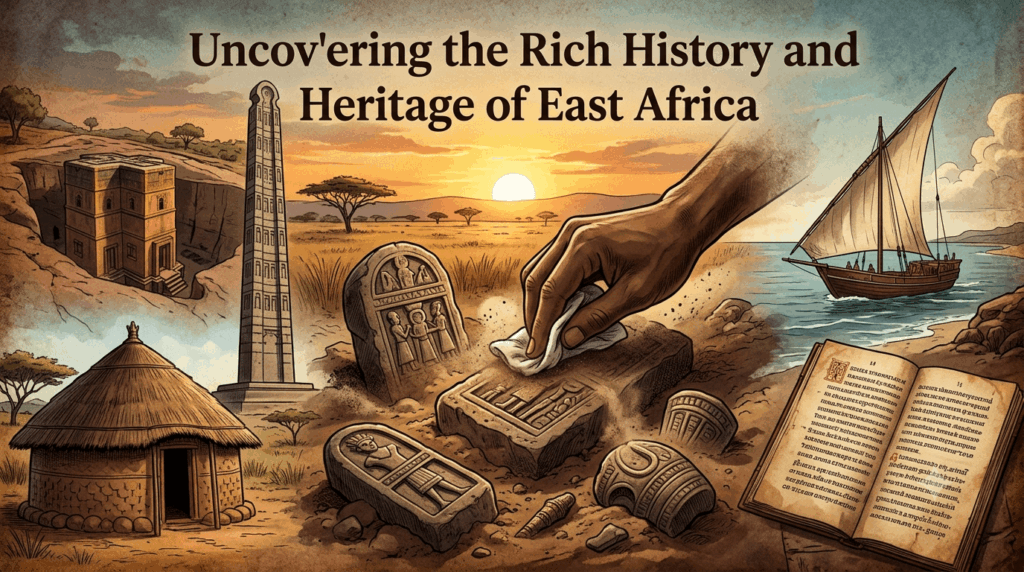
When the world thinks of East Africa, the mind often wanders to the sweeping, wildlife-rich savannahs of the Serengeti, the spice-scented, labyrinthine alleys of Zanzibar, or the rolling green hills of Rwanda. But to truly understand the deep, foundational history of the East African region, one must look to its northern anchor, its historical heavyweight, and its spiritual compass: Ethiopia.
Ethiopia isn’t just a country situated in the Horn of Africa; it is the region’s historical cradle. It is a land where the story of humanity literally began, where ancient empires traded with Rome and China, and where the spirit of African independence was fiercely defended.
Here at EthioBrief, we believe that you cannot tell the story of East Africa without placing Ethiopia at the very center of the narrative. Let’s uncover the rich history and heritage of the region by exploring the enduring legacy of the Ethiopian empire.
1. The Cradle of Humankind: Where the Story Begins
Before there were borders, languages, or nations, there was the Great Rift Valley. While this massive geological trench runs through several East African countries, its most profound historical treasures are unearthed in Ethiopian soil.
Ethiopia is globally recognized as the “Cradle of Humankind.” In the sun-baked earth of the Afar region, paleoanthropologists discovered “Dinkinesh” (known to the West as Lucy), a 3.2-million-year-old hominid fossil that rewrote our understanding of human evolution. Later, the discovery of “Ardi” (Ardipithecus ramidus) pushed our ancestral timeline back even further to 4.4 million years.
When you explore Ethiopia’s heritage, you aren’t just looking at the history of a nation; you are looking at the origin story of the entire human race. Ethiopia provides the literal roots for East Africa and the world beyond.
2. The Aksumite Empire: East Africa’s Ancient Superpower
Long before the modern map of East Africa was drawn, the Aksumite Empire (centered in northern Ethiopia and Eritrea) was a global superpower. In the 3rd century AD, the Persian prophet Mani listed Aksum as one of the four great powers of the world, alongside Rome, Persia, and China.
Aksum was a master of maritime trade, controlling the Red Sea routes and connecting the African interior to the Middle East, India, and the Mediterranean. They were the first sub-Saharan African state to mint their own gold, silver, and bronze coins. Furthermore, they developed Ge’ez, an ancient script that remains the foundation for modern Amharic and Tigrinya, making it the only indigenous African writing system still in widespread use today.
The towering granite obelisks (stelae) of Axum still stand today as silent, magnificent witnesses to a time when an East African empire dictated the flow of global commerce.
3. A Sanctuary of Faith: The Coexistence of the Divine
East Africa is a region of deep spiritual diversity, and Ethiopia is its oldest sanctuary. In the 4th century, the Aksumite Empire became one of the first countries in the world to officially adopt Christianity. This ancient faith birthed architectural marvels that defy logic, such as the 12th-century rock-hewn churches of Lalibela, carved top-down into solid volcanic rock.
But Ethiopia’s religious heritage is also deeply intertwined with Islam. When the early followers of Prophet Muhammad faced severe persecution in Mecca, the Prophet advised them to seek refuge in Axum, ruled by a just Christian king known as Negashi (King Armah). This event, known as the First Hijra, established a legacy of religious tolerance. Today, the Al-Nejashi mosque in Tigray is one of the oldest and most revered Islamic sites in Africa.
This unique, centuries-old coexistence of Orthodox Christianity and Islam forms the spiritual bedrock of the Horn of Africa.
4. The Battle of Adwa and the Beacon of Pan-Africanism
To understand the modern political heritage of East Africa, you must understand Adwa.
In the late 19th century, European powers gathered at the Berlin Conference to carve up the African continent. While the rest of East Africa—and indeed the entire continent—fell under colonial rule, Ethiopia stood firm. In 1896, at the Battle of Adwa, Ethiopian forces, united under Emperor Menelik II and Empress Taytu Betul, decisively defeated the invading Italian army.
This victory sent shockwaves across the globe. Ethiopia remained unconquered, becoming a powerful symbol of Black resistance and freedom. For decades, Ethiopia served as the spiritual home of Pan-Africanism. When East African nations like Kenya, Tanzania, and Uganda finally won their independence in the mid-20th century, they looked to Ethiopia for inspiration. It is no coincidence that when the Organization of African Unity (now the African Union) was formed, its headquarters were established in Addis Ababa. Ethiopia’s unconquered spirit is the shield that guards the pride of the entire continent.
5. The Gadaa System and the Mosaic of the Horn
East Africa is renowned for its vibrant ethnolinguistic diversity, and Ethiopia is a perfect microcosm of this beautiful mosaic. With over 80 ethnic groups—including the Oromo, Amhara, Tigray, Somali, Sidama, and Afar—Ethiopia’s cultural heritage is staggeringly rich.
A shining example of this indigenous heritage is the Gadaa system of the Oromo people. Recognized by UNESCO as an Intangible Cultural Heritage of Humanity, the Gadaa is a complex, egalitarian socio-political and democratic system that has governed Oromo society for centuries. It dictates everything from political elections and dispute resolution to environmental conservation and social welfare.
Indigenous systems like the Gadaa remind us that long before Western democratic models were introduced to East Africa, sophisticated, homegrown systems of governance and community care were already thriving in the Ethiopian highlands and lowlands.
Final Thoughts: The Heartbeat of the Horn
To uncover the history of East Africa is to trace the rivers, trade routes, and migrations that all eventually lead back to the Ethiopian highlands. From the fossils of our earliest ancestors to the diplomatic halls of the African Union, Ethiopia’s heritage is the thread that binds the region’s past to its future.
It is a history written in stone, sung in ancient chants, and lived out daily in the bustling markets of Addis Ababa and the pastoral lands of the Rift Valley.
What part of Ethiopia’s rich history fascinates you the most? Are you planning a trip to walk in the footsteps of the Aksumite kings or marvel at the churches of Lalibela? Share your thoughts in the comments below!
Stay curious, stay proud. For more deep dives into Ethiopian culture, history, and current affairs, keep reading EthioBrief.
About The Author