Ethiopia Travel SIM Cards: A Complete Guide
Staying connected in Ethiopia requires a bit of planning. Unlike many countries where you can pick up a cheap SIM at any corner shop, Ethiopia has strict registration rules and a telecom market that is still developing. The good news is that getting a travel SIM card in Ethiopia is straightforward if you know what to expect.
Ethiopia has two mobile operators: Ethio Telecom, the state-owned incumbent, and Safaricom Ethiopia, a private operator that entered the market in 2022. Ethio Telecom has broader coverage and special tourist packages. Safaricom offers faster speeds in cities but a smaller network footprint.
This guide covers everything a visitor needs to know: where to buy a SIM, what documents you need, current prices, coverage expectations, and practical tips for staying online during your trip.
Ethiopia’s Two Mobile Networks
Ethio Telecom is the dominant operator with approximately 87 million subscribers as of late 2025. It owns most of the country’s fiber-optic network and mobile towers. Its 4G coverage reaches about 82% of the population, with plans to expand to 95.5% through partnerships with Ericsson and ZTE.
Safaricom Ethiopia launched commercially in October 2022. By March 2026, it had 13.6 million active subscribers and operated roughly 3,500 network sites, covering about 59% of the population. Its network is entirely 4G-enabled and 5G-ready, but its footprint is concentrated in cities and major towns.
For travelers, this means Ethio Telecom is the safer choice if you plan to travel outside Addis Ababa. Safaricom works well in the capital and larger cities but may have gaps in rural areas.
Where to Buy a SIM Card in Ethiopia
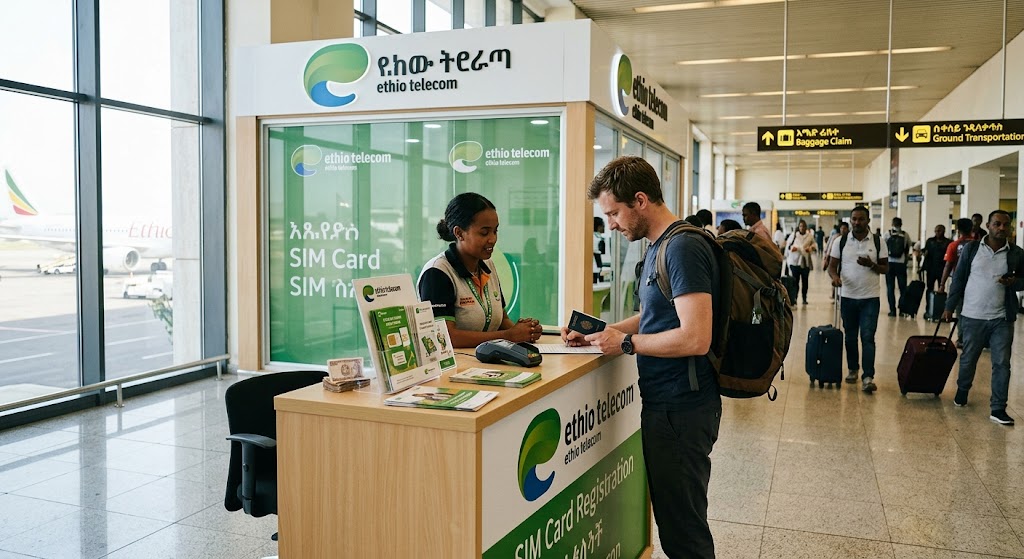
The easiest place for arriving travelers is Addis Ababa Bole International Airport. Both operators have counters in the arrivals area. Ethio Telecom sells its International Visitor Plans there, and staff can register the SIM on the spot using your passport.
Outside the airport, you can buy SIM cards at official operator stores in cities and towns. Ethio Telecom has retail shops across the country. Safaricom has stores concentrated in Addis Ababa and other major cities.
Avoid buying SIM cards from street vendors or unofficial resellers. Registration rules are strict, and an improperly registered SIM can be deactivated. Always buy from an official operator store or authorized agent.
SIM Card Registration Requirements
Ethiopia requires all SIM cards to be registered under a valid ID. The rules are set by the Ethiopian Communications Authority.
For visitors, the requirements are:
- An original or certified copy of a valid passport
- A local address where you can be reached during your visit
- A contact phone number
You must appear in person to register. The operator or agent will enter your details into the National Subscriber Registry.
Registration is usually quick at the airport counter. Bring your passport and have your hotel address ready. The whole process takes about 10 to 15 minutes.
Ethio Telecom International Visitor Plans
Ethio Telecom offers dedicated packages for tourists and short-term visitors. These are priced in USD or Euros and include generous data allowances.
Weekly Plan — $10
- 30 GB data
- 300 minutes for local calls to any network
- 300 SMS to any network
- 100 ETB airtime credit
Bi-Weekly Plan — $20
- 60 GB data
- 300 minutes for local calls
- 300 SMS
- 30 minutes of international voice calls
- 300 ETB airtime credit
Monthly Plan — $40
- Unlimited data
- Unlimited local calls
- Unlimited SMS
- 90 minutes of international voice calls
- 500 ETB airtime credit
All prices are tax-inclusive. The international voice minutes can be used to call over 130 countries, including the United States, United Kingdom, Canada, and most of Europe.
These visitor plans are only available at designated locations, primarily the airport and select Ethio Telecom stores. They are not the same as regular local packages, which are priced in Ethiopian birr and require local registration.
Safaricom Options for Visitors
Safaricom Ethiopia does not offer a dedicated tourist SIM package like Ethio Telecom. Visitors can buy a standard Safaricom SIM by presenting a passport at an official store. The SIM must be registered under the same rules as any other subscriber.
Safaricom’s pricing is generally higher than Ethio Telecom’s for comparable data volumes. The operator raised mobile data prices by an average of 44% in late 2025, citing currency depreciation and network costs.
If you want to try Safaricom, buy a small package first to test coverage in your area. Safaricom works best in Addis Ababa and major regional cities. Outside those areas, Ethio Telecom is more reliable.
Coverage and Speed Expectations
Ethiopia’s mobile internet speeds are among the slowest measured globally. Median fixed broadband speeds have been tracked near 9–12 Mbps, with mobile running in a similar range outside central Addis Ababa.
In Addis Ababa: Both operators offer 4G. Ethio Telecom has expanded 5G coverage to central areas and several dozen other cities. Speeds are usable for messaging, maps, and light browsing. HD video calls work in the capital but may be inconsistent.
In regional cities: 4G is available in towns like Bahir Dar, Gondar, Mekelle, and Hawassa. Speeds are slower than the capital but adequate for basic use.
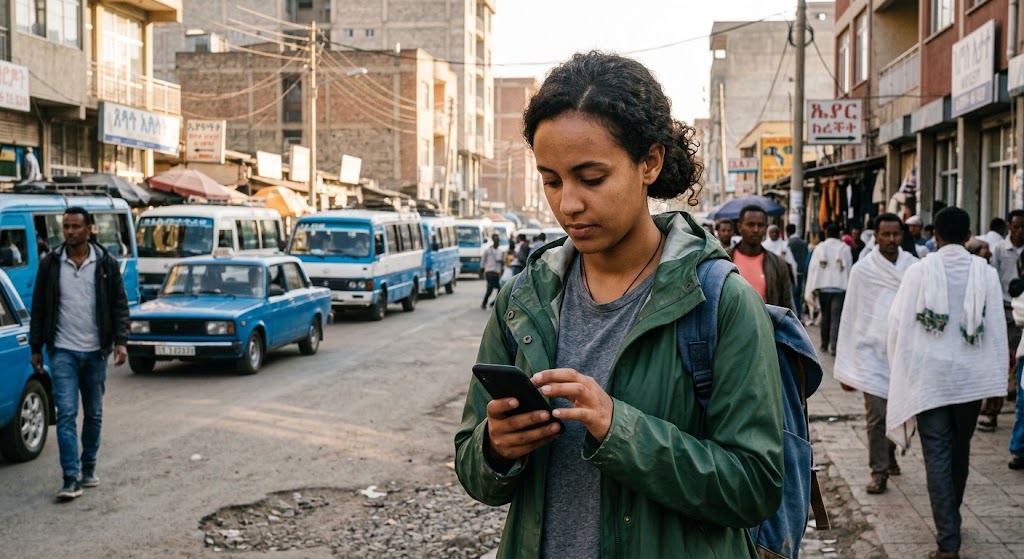
In rural areas and national parks: Coverage thins quickly. Expect 3G or no signal in remote highlands and desert regions. Download offline maps before you travel.
Important note: Ethiopia periodically imposes network shutdowns in certain regions for security reasons. During a shutdown, both local SIMs and eSIMs roaming on Ethiopian networks are affected. No provider can route around a shutdown. Plan for offline navigation and communication.
eSIM Options for Ethiopia
If your phone supports eSIM, you have an alternative to buying a physical SIM. Several international providers sell Ethiopia eSIM plans that roam on local networks.
eSIM plans typically connect to Safaricom Ethiopia or Ethio Telecom, depending on the provider. Prices range from about $6 for 1 GB to over $90 for 20 GB.
The advantage of eSIM is convenience. You can install it before you travel and activate it when you land. No need to visit a store or wait in line. The disadvantage is that eSIM plans are often data-only, with no local phone number for calls or SMS.
If you need a local number for hotel bookings or local calls, a physical SIM is still the better choice.
Practical Tips for Staying Connected
Buy at the airport if you can. The Ethio Telecom counter at Bole International Airport is the easiest place to get a registered tourist SIM. Staff are used to helping visitors, and the process is quick.
Download offline maps before you leave. Google Maps and Maps.me allow you to download offline maps for Ethiopia. This is essential for travel outside cities where signal may be weak or unavailable.
Use telebirr for top-ups. Ethio Telecom’s telebirr app lets you buy airtime and data packages directly. The app offers a 20% discount on data purchases compared to other channels. You can also use telebirr for mobile money transactions, bill payments, and transfers.
Keep your home SIM active. If you use a dual-SIM phone, keep your home SIM in one slot for calls and SMS while the Ethiopian SIM handles data. Turn off data roaming on your home line to avoid charges.
Test coverage before committing. If you plan to travel extensively, buy a small Ethio Telecom package first. If you find coverage is good in your areas, top up with a larger bundle. Ethio Telecom’s monthly 100 GB package offers better value than Safaricom for heavy data users.
Quick Tips
- Bring your passport. You cannot buy a SIM card in Ethiopia without valid ID. The registration is done in person at the point of sale.
- Check phone compatibility. Make sure your phone is carrier-unlocked before you travel. An unlocked phone will accept any local SIM.
- Consider both operators. Some travelers keep SIMs from both Ethio Telecom and Safaricom for backup coverage.
- Watch for fair usage limits. Unlimited plans from both operators may reduce speeds after a certain threshold. Read the terms before buying.
- Verify current prices. Both operators raised prices in late 2025 and early 2026. Rates change frequently, so confirm current packages at the point of purchase.
Frequently Asked Questions
Can tourists buy a SIM card in Ethiopia?
Yes. Visitors can buy SIM cards from Ethio Telecom or Safaricom by presenting a valid passport. Ethio Telecom offers special International Visitor Plans at Addis Ababa Bole International Airport with generous data allowances and local call minutes.
Which operator has better coverage in Ethiopia?
Ethio Telecom has broader coverage, reaching about 82% of the population with 4G and extending into rural areas. Safaricom covers about 59% of the population, concentrated in cities and major towns. For travel outside major cities, Ethio Telecom is the more reliable choice.
Do I need an eSIM or a physical SIM for Ethiopia?
It depends on your needs. An eSIM is convenient if you want data-only service and don’t need a local phone number. A physical SIM gives you a local number for calls and SMS, and Ethio Telecom’s tourist plans include call minutes. If you need to make local calls, choose a physical SIM.
Other Posts From Ethiobrief
- Ethio Telecom vs. Safaricom: Data Package Comparison — A detailed price and coverage comparison.
- Using telebirr: Ethiopia’s Mobile Money App — A practical guide for visitors and residents.
- Internet Access in Addis Ababa: Cafes, Coworking, and Wi-Fi — Where to find reliable connections.
- Ethiopia Travel Safety and Health — Practical advice including connectivity for emergencies.
- eSIM vs Physical SIM for Africa Travel — General guidance for travelers across the continent.
About The Author