The Story of Coffee: From Ethiopia to the World
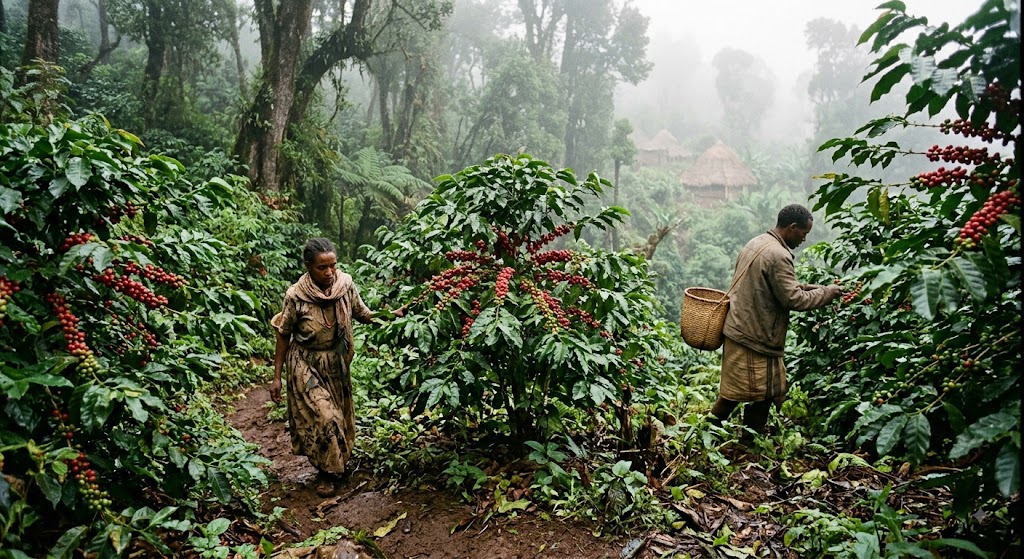
More than a thousand years ago, in the highlands of Ethiopia, a goatherd made a strange discovery. His goats, after eating the red berries of a wild bush, became unusually lively and refused to sleep. Curious, he tried the berries himself and felt a remarkable sense of refreshment and energy.
Whether this story is entirely true remains uncertain. But the legend of Kaldi the goatherd who first noticed coffee’s effects has endured for centuries. And it points to a historical fact that few dispute: Ethiopia is the birthplace of coffee.
From these ancient forests, coffee would eventually travel across the Red Sea to Arabia, then to Europe, and eventually to every corner of the globe. Today, it is one of the most popular beverages in the world. But the story of coffee begins in one specific place: the tropical highlands of Ethiopia.
The Legend of Kaldi and the Origins of Coffee
The most famous story about coffee’s discovery comes from Ethiopia. According to legend, a goatherd named Kaldi noticed that his goats became unusually energetic after eating red berries from a certain bush. The goats were jumping around and refusing to sleep behavior Kaldi had never seen before.
Kaldi tried the berries himself and felt a similar effect. He took the berries to a local monastery, where a monk decided to experiment with them. The monk roasted the beans, poured boiling water over them, and discovered a drink that helped him stay awake during long prayers.
It is worth noting that historians have found no written evidence that Kaldi actually existed. The legend is folklore, not documented history. But it remains an important part of coffee’s cultural story and it consistently points to Ethiopia as the place where coffee was first discovered.
From Ethiopian Forests to the Arabian Peninsula
While the Kaldi legend is unproven, the historical record shows that coffee was first cultivated commercially in Yemen, on the southwestern tip of the Arabian Peninsula. The earliest written records of coffee consumption date back to the 15th century in Yemen.
Sufi mystics in Yemen were among the first people to roast and brew coffee beans into a drink. They used it to stay awake during all-night religious ceremonies. Coffee’s ability to keep people alert made it valuable for spiritual practice.
The coffee plant itself had crossed the Red Sea from Ethiopia to Yemen, likely through trade routes that connected the Horn of Africa with Arabia. From Yemen, coffee spread to the rest of the Middle East, then to Europe and beyond.
Why Ethiopia Is the Birthplace of Coffee
Botanists and scientists agree that Ethiopia is the center of origin, diversification, and dissemination of the coffee plant. More genetically diverse strains of Coffea arabica exist in Ethiopia than anywhere else in the world.
Coffea arabica grew wild in the forests of southwestern Ethiopia particularly in the Kaffa and Buno regions for thousands of years. The word “coffee” itself is believed to be related to Kaffa, the region where coffee was discovered.
Even today, Ethiopia remains the home of the Arabica coffee bean. It is the fifth largest coffee producer globally and the largest in Africa. Ethiopian coffee is prized for its unique flavors, which vary significantly depending on the region where it is grown.
Ethiopia’s Major Coffee Regions
Ethiopia produces some of the most distinctive and highly regarded coffees in the world. Each region offers a different flavour profile, shaped by soil, altitude, and climate.
Yirgacheffe is perhaps the most famous Ethiopian coffee region. Coffees from Yirgacheffe are known for their bright acidity, floral aromas, and tea-like qualities. The region’s volcanic and clay soils, combined with a moderate climate, allow slow cherry ripening that preserves delicate flavours. Yirgacheffe coffees often score between 88 and 91 on professional cupping evaluations.
Sidama produces coffees with spicy and flowery fragrances. The region’s volcanic, loamy soils are rich in nutrients that enhance flavour complexity and clarity. Sidama coffees are known for their medium body and bright acidity.
Harar, in eastern Ethiopia, produces bold, earthy coffees with fruity and wine-like qualities. Harar coffees have a distinct mocha flavour and a heavier body.
Other notable regions include Limu, known for its winy flavours, and Jimma, which is recognised for coffee production and a deep-rooted coffee ceremony tradition.
The Ethiopian Coffee Ceremony
Coffee in Ethiopia is more than just a drink. It is a social ritual, a mark of hospitality, and a deeply rooted cultural tradition.
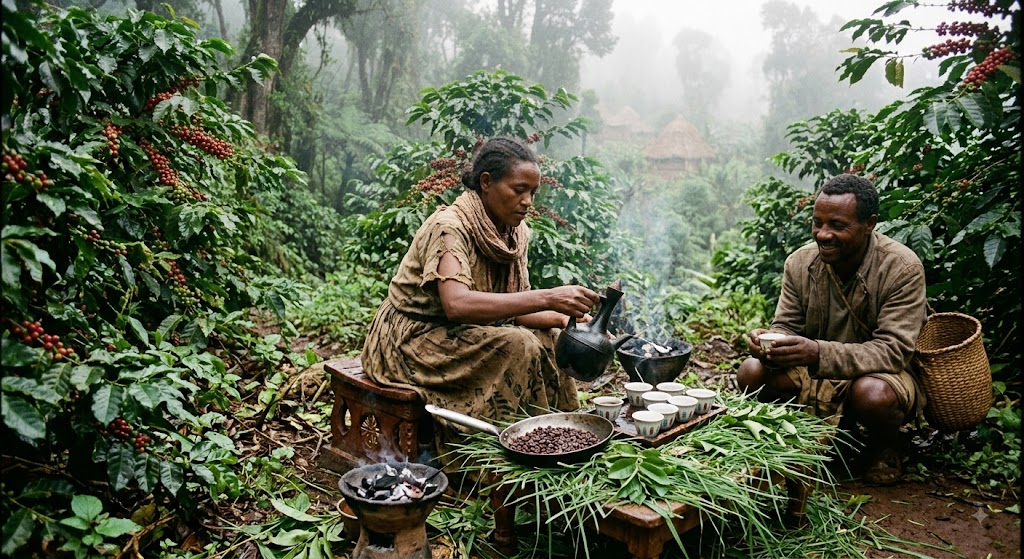
The Ethiopian coffee ceremony is a structured process that can take over an hour. It is traditionally performed by women. The ceremony involves several steps:
- Coffee beans are washed and roasted over an open flame
- The roasted beans are ground by hand using a mortar and pestle
- The ground coffee is brewed in a jebena, a traditional clay coffee pot
- The coffee is poured and served, often accompanied by incense and popcorn or other snacks
The ceremony is performed three times, with each round having a different name. Guests typically drink three cups of coffee during the ceremony.
In February 2025, Ethiopia held a national workshop to prepare its nomination file for UNESCO Intangible Cultural Heritage recognition for the coffee ceremony. The initiative is a coordinated effort to safeguard the tradition and strengthen Ethiopia’s position in the global coffee industry.
Coffee Spreads Across the World
From Ethiopia, coffee travelled to Yemen, where it was first cultivated as a commercial crop in the 1540s. By the 17th century, coffee had reached Europe through Venetian merchants and Dutch traders.
Coffee houses became important social spaces in cities across Europe. People gathered there not just to drink coffee, but to read newspapers, discuss politics, and conduct business.
The spread of coffee was not without its dark side. The expansion of coffee plantations in the Caribbean and beyond relied on enslaved labour under brutal conditions. This history is an uncomfortable but important part of coffee’s global story.
Today, coffee is grown in dozens of countries across the tropics. But its genetic and cultural roots remain in Ethiopia.
Quick Tips
- Visit during the harvest season: If you travel to Ethiopia’s coffee regions, the main harvest runs from October to December. This is when you can see coffee cherries being picked and processed.
- Experience a coffee ceremony at a local home: The most authentic coffee ceremonies happen in homes, not hotels. If you are invited to one, it is a sign of respect and welcome.
- Ask about the region when buying coffee: Ethiopian coffees taste very different depending on where they are grown. Ask your seller about whether it is Yirgacheffe, Sidama, or Harar.
- Support traceable coffee: Some Ethiopian coffee now comes with traceability information showing which farm or co-op produced it. This helps farmers earn more for their work.
- Check current export rules: Coffee export regulations in Ethiopia are evolving. If you plan to buy and export coffee, check the latest rules through the Ethiopian Coffee and Tea Authority.
Frequently Asked Questions
Was coffee really discovered by a goatherd named Kaldi?
The story of Kaldi is a legend, not a verified historical fact. There is no written evidence that Kaldi ever existed. However, the legend consistently points to Ethiopia as the birthplace of coffee, which is supported by botanical and historical evidence.
What is the Ethiopian coffee ceremony?
The Ethiopian coffee ceremony is a traditional social ritual involving the roasting, grinding, and brewing of coffee in a jebena (clay pot). It is performed by women and can take over an hour. The ceremony is an important part of Ethiopian hospitality and social life, and Ethiopia is seeking UNESCO recognition for it.
Why is Ethiopian coffee considered special?
Ethiopia is the home of Coffea arabica, and it has more genetic diversity of coffee than any other country. Ethiopian coffees are known for their distinct and varied flavor profiles, which range from floral and citrusy to bold and wine-like. The diversity of soil, climate, and altitude across Ethiopia’s coffee regions creates unique flavors that cannot be found elsewhere.
About The Author