Kings, Castles, and Conquerors: The Legacy of Ethiopia’s Royal Dynasties
Ethiopia’s history is not a single line of kings. It is a series of dynasties, each with its own capital, its own claims to legitimacy, and its own architectural legacy. From the towering stelae of Aksum to the rock-hewn churches of Lalibela and the castles of Gondar, the country’s royal past is written into the landscape.
Understanding Ethiopian royal dynasties means looking beyond the famous Solomonic line. It means recognizing the Zagwe kings who built Lalibela, the emperors who made Gondar a capital of stone, and the rulers who fought to keep Ethiopia independent when much of Africa was being colonized. Each dynasty left its mark, and each one tells us something about how power was claimed, defended, and remembered in the Ethiopian highlands.
This guide covers the major royal houses, their most important monuments, and what visitors can still see today.
Aksum: The First Great Kingdom
Before there were emperors in Gondar or kings in Lalibela, there was Aksum. This ancient kingdom, centered in the northern highlands, controlled trade routes linking the Mediterranean to the Indian Ocean. It minted its own coins, developed its own script, and built monuments that still stand today.
Aksum’s most visible legacy is its stelae: towering granite obelisks carved from single blocks of stone. The largest standing stela is about 21 meters tall, decorated with carvings that depict a multi-story building. These monuments marked royal tombs and proclaimed the power of Aksumite rulers.
In the fourth century, King Ezana converted to Christianity, tying the kingdom to the broader Christian world and laying the foundation for the Ethiopian Orthodox Church. Aksum’s decline came gradually, as trade routes shifted and the kingdom’s political center weakened.
What to see today: The stelae field, the tombs of Kings Kaleb and Gebre Meskel, and the Church of St. Mary of Zion. The site is a UNESCO World Heritage Site, inscribed in 1980.
The Zagwe Dynasty: Builders of Lalibela
After Aksum’s decline, a new dynasty emerged from the Lasta region, further south. The Zagwe kings, likely of Agaw origin, established their capital at Roha, later renamed Lalibela after their most famous ruler.
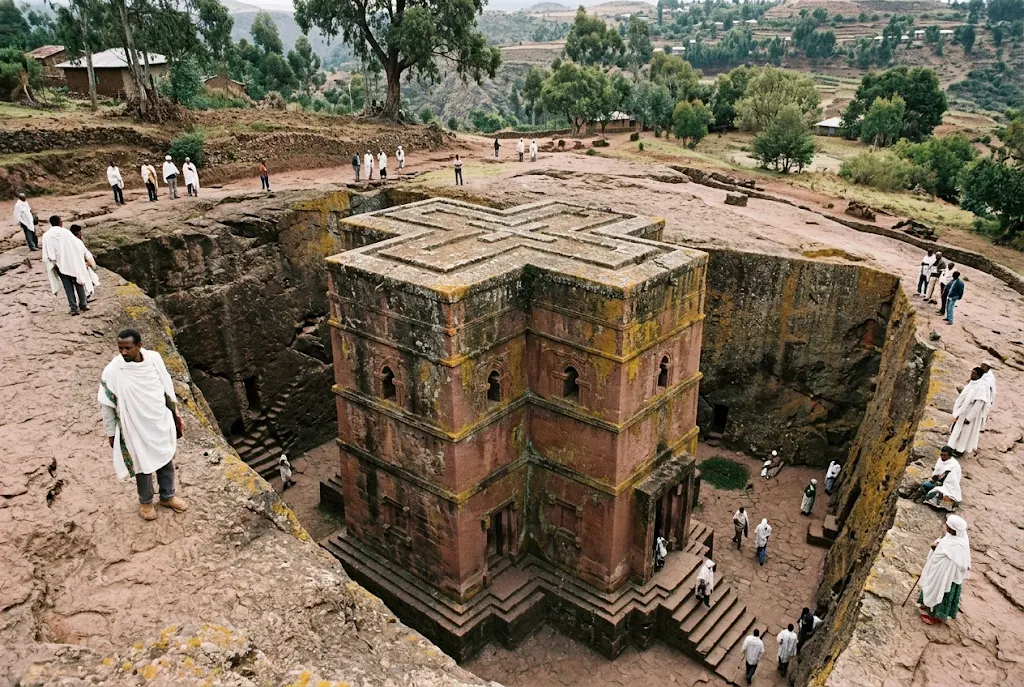
The Zagwe are remembered for one monumental achievement: the rock-hewn churches of Lalibela. These eleven churches were carved downward from solid volcanic rock, creating a complex of tunnels, trenches, and places of worship that remains active today. King Lalibela is credited with commissioning the churches, though scholars debate the exact timeline and stages of construction.
Later Solomonic historians portrayed the Zagwe as usurpers, illegitimate rulers who interrupted the true line of kings. But modern scholarship paints a more nuanced picture. The Zagwe adopted Christianity, patronized the church, and produced rulers who were later venerated as saints. Their legacy is not one of interruption, but of innovation.
What to see today: The eleven churches of Lalibela, a UNESCO World Heritage Site since 1978. Bete Giyorgis, the cross-shaped church, is the most iconic.
The Solomonic Dynasty: Restorers of an Ancient Line
In 1270, a new dynasty took power, claiming descent from the biblical King Solomon and the Queen of Sheba. This was the Solomonic dynasty, founded by Yekuno Amlak. The claim was codified in the Kebra Nagast, a national epic that linked Ethiopian kingship to the ancient world and to God’s chosen lineage.
The Solomonic dynasty lasted, in one form or another, for nearly six centuries. It survived Muslim invasions, internal rebellions, and the shifting fortunes of regional lords. Its emperors moved their capitals frequently, ruling from mobile camps and temporary palaces before settling in Gondar.
The dynasty’s legitimacy was not just political; it was religious. The Kebra Nagast and the story of Menelik I, the son of Solomon and Sheba, gave Ethiopian kings a sacred mandate. To be emperor was to be the guardian of this covenant.
Gondar: The City of Castles
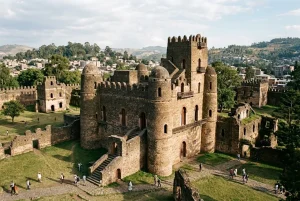
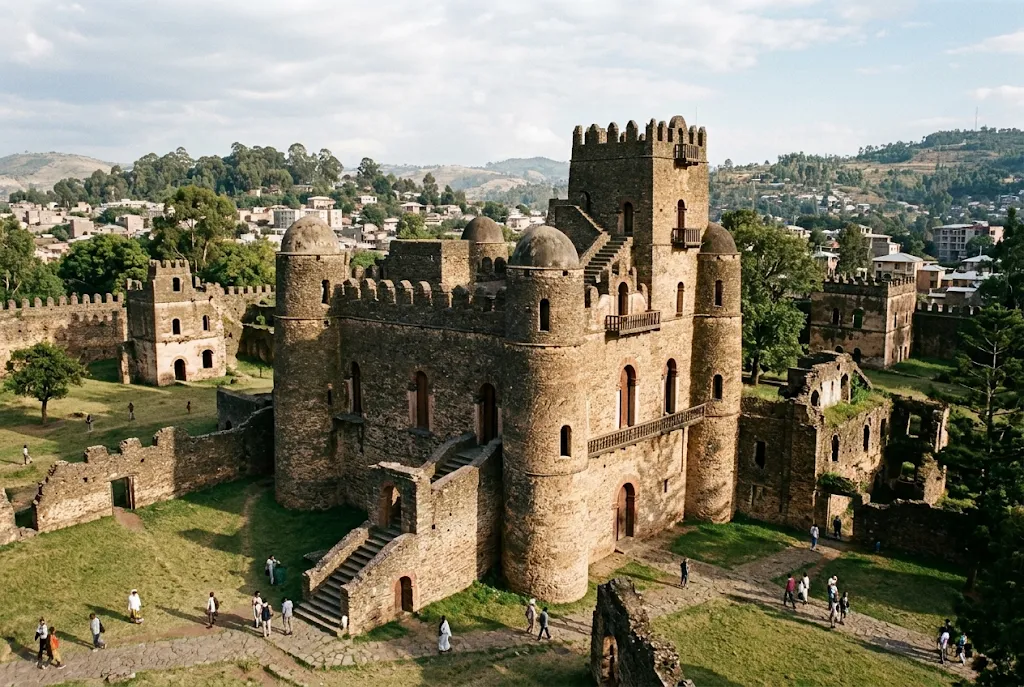
In 1636, Emperor Fasilides established Gondar as a permanent capital. For the first time in centuries, Ethiopian emperors built in stone rather than tents. The result was Fasil Ghebbi, a royal enclosure containing castles, palaces, a library, and a banqueting hall.
The architecture is striking. The main castle has tall towers and battlemented walls, reminiscent of European medieval fortresses. Scholars believe the designs incorporated the skills of Italian or Indian masons, reflecting Ethiopia’s connections with the wider world. Each emperor built his own castle, often ignoring those of his predecessors, creating a compound of competing monuments.
Gondar remained the capital until the mid-nineteenth century, though its power declined during the chaotic Era of the Princes (roughly 1706–1853). During that period, regional warlords held real power while emperors ruled in name only.
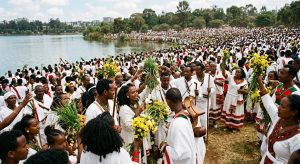
What to see today: Fasil Ghebbi, the royal enclosure, a UNESCO World Heritage Site since 1979 . Also visit the Bath of Fasilides, where Timkat is still celebrated each year.
The Era of Princes and the Return of Central Power
The Solomonic line weakened in the eighteenth century. Regional lords, known as Rases, gained power while emperors became figureheads. This period, the Era of the Princes (Zemene Mesafint), saw rival warlords compete for influence and control of the throne.
Central authority was restored in the mid-nineteenth century by Emperor Tewodros II, who ended the anarchy and sought to reunify the country. His successors, Yohannes IV and Menelik II, continued the project of centralization and modernization.
Menelik II is remembered for two achievements. He founded Addis Ababa as his capital in the late nineteenth century. And in 1896, his forces defeated an invading Italian army at the Battle of Adwa, securing Ethiopia’s independence and making it a symbol of African sovereignty.
The Last Emperor and the End of Monarchy
The Solomonic line continued, with interruptions, into the twentieth century. Haile Selassie I was crowned emperor in 1930, after serving as regent for Empress Zewditu. He modernized the state, abolished slavery, and gave Ethiopia its first written constitution.
Italy occupied Ethiopia from 1936 to 1941, forcing Haile Selassie into exile. He returned after the British and Ethiopian forces liberated the country. His second reign saw Ethiopia become a founding member of the United Nations and host the headquarters of the Organization of African Unity (now the African Union) in Addis Ababa.
The monarchy ended in 1974, when a military junta, the Derg, overthrew Haile Selassie. The emperor died in detention the following year. The dynasty that had claimed descent from Solomon and Sheba for centuries was no more.
What Visitors Can See Today
Ethiopia’s royal legacy is not confined to museums. It is visible in the landscape, in monuments, and in living traditions.
- Aksum: Stelae field, royal tombs, Church of St. Mary of Zion. UNESCO site since 1980.
- Lalibela: Eleven rock-hewn churches, still active places of worship. UNESCO site since 1978.
- Gondar: Fasil Ghebbi castle complex, Bath of Fasilides, Debre Berhan Selassie church. UNESCO site since 1979.
- Addis Ababa: Menelik II’s palace (now part of Unity Park), the National Museum, and the Adwa Victory Memorial.
Visitors should remember that these are not just historical sites. Lalibela is a living pilgrimage destination. Gondar’s Timkat celebration draws thousands. The legacy of the kings is still felt in the rhythms of Ethiopian religious and cultural life.
Quick Tips
- Visit Lalibela outside major festival days if you want space. Timkat and Genna draw huge crowds, which is an experience in itself but not for quiet contemplation.
- Hire a licensed guide at Aksum. The stelae carvings and tomb layouts are easier to understand with explanation.
- Give yourself a full day in Gondar. The castle complex, the bath, and the church are spread out and deserve time.
- Check travel advisories for Tigray and Amhara regions. Conditions can change, and some sites may be difficult to access.
- Read the Kebra Nagast before you go. Even a summary will help you understand the religious and political claims that shaped Ethiopian kingship.
Frequently Asked Questions
Which Ethiopian dynasty built the castles of Gondar?
The castles of Gondar were built by emperors of the Solomonic dynasty, beginning with Emperor Fasilides in the seventeenth century. Each subsequent emperor added his own castle or building within the royal enclosure.
What was the Zagwe dynasty known for?
The Zagwe dynasty is best known for commissioning the rock-hewn churches of Lalibela. These eleven churches were carved from solid rock and remain a UNESCO World Heritage Site and active pilgrimage destination.
Who was the last emperor of Ethiopia?
Haile Selassie I was the last emperor of Ethiopia. He reigned from 1930 until 1974, when he was overthrown by the Derg military junta. The monarchy was abolished, ending centuries of royal rule.
About The Author